
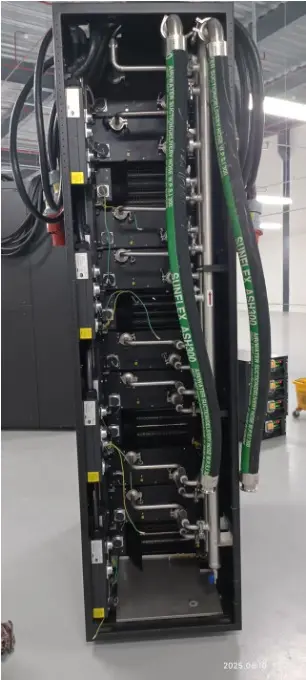
Liquid manifolds and connections on a high-density AI rack emulator

Commissioning use | Liquid cooling

Heat Load Testing for High-Density AI Data Centres

Prove the cooling system before the AI racks arrive.

Controlled rack and hall-scale thermal loads allow the project team to observe the liquid-cooling system at realistic demand before production servers are installed or placed at risk.

AI rack density is changing how cooling systems are commissioned.

Traditional server halls relied primarily on air cooling. High-density AI environments increasingly use direct-to-chip liquid cooling, CDUs, secondary loops and hybrid air/liquid racks with materially higher rack heat density.

Controlled thermal load allows the project team to observe:

  • Supply and return temperature
  • Liquid flow
  • Pressure and differential pressure
  • CDU response
  • Pump response
  • Cooling capacity
  • Controls and alarms
  • Redundancy and recovery

Follow the heat path from rack to rejection.

Rack emulators create a predictable thermal source so each part of the liquid path can be observed under the approved test procedure.

Rack-scale precision. Zone and hall-scale capacity.

Equipment can be selected around a rack branch, CDU, cooling zone or wider hall requirement.

RACK-SCALE LOAD

240 / 300 kW AI rack emulators

Reproduce a high-density rack's electrical and thermal profile at the branch and rack connection. The 240 kW platform combines 192 kW liquid with 48 kW air; the 300 kW platform applies a full-liquid thermal load.

  • CDU branch and secondary-loop validation
  • Direct-to-chip cooling response
  • Hybrid air/liquid interaction
  • Rack failure and recovery scenarios
ZONE / HALL-SCALE LOAD

300-600 kW liquid load systems

Apply larger liquid thermal loads by CDU, zone or hall. Modular multi-unit deployments allow capacity, stability and redundancy testing beyond an individual rack.

  • CDU capacity and stability
  • Liquid distribution commissioning
  • Cooling-system capacity
  • Retrofit and expansion validation

Observe steady-state response, transitions and recovery.

The test team defines operating points and scenarios. AMOR supports the equipment condition required to create them.

Stabilize

Introduce controlled demand and allow the liquid and heat-rejection system to reach the approved observation condition.

Observe

Capture equipment-side temperature, flow, pressure and electrical data where available while project systems are witnessed.

Transition

Maintain or change load as approved pumps, CDUs, cooling assets or power paths transition.

Recover

Support repeatable conditions while the system returns to normal operation or the scenario is repeated.

Equipment + field support + project response.

AMOR combines specialized temporary load equipment with the coordination, electrical capability and technical response required to deploy it around real construction schedules.

Equipment availability and deployment capacity are confirmed against each project's schedule and requirements.

  • Specialized high-density equipment
  • Rack-scale through MW-scale load
  • Air, liquid and hybrid simulation
  • North American project coordination
  • Electrical field capability
  • Project-specific technical configuration

Technical discovery

Send us your cooling architecture

Share what is currently known. These details guide the first technical review and do not all need to be complete before a discussion.

01Project location02Commissioning stage03Planned test date04Electrical load requirement05Rack density and voltage06Air / liquid / hybrid cooling07Anticipated equipment quantity08Test duration09Owner / CxA requirements, if available