Rack level | Full liquid

300 kW Full-Liquid AI Rack Emulator

Rack-scale liquid thermal emulation for next-generation high-density AI infrastructure.

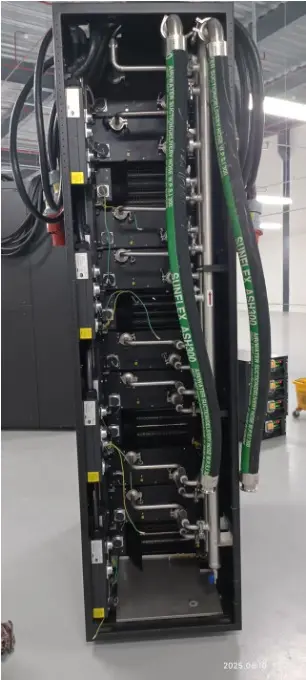
Rear liquid connections and manifolds on a full-liquid AI rack emulator
Liquid load300 kW
ArchitectureFull liquid
Voltage380-480 V
Resolution1 kW

Commission the infrastructure before compute goes live.

Introduce a controlled 300 kW rack-scale liquid thermal load without relying on production servers. The platform supports direct-to-chip cooling validation, CDU capacity testing, secondary-loop commissioning and repeatable redundancy and recovery scenarios.

Technical specifications

Rated power
300 kW
Cooling architecture
Full liquid
Rated voltage
AC 380 / 400 / 415 / 480 V
Loading resolution
1 kW
Reference dimensions
600 x 1300 x 2300 mm
Power factor
1.0 resistive load
Control
Local touchscreen; remote control optional
Monitoring
Voltage, current, active power, frequency, liquid-side temperature, flow and pressure functions
Protection
Over-voltage, over-current, over-temperature, overload, low-flow, high-temperature and leak protection
Environment
+5 C to +50 C; RH <= 90%; altitude <= 1500 m
Enclosure
IP20 indoor
Technology & Manufacturing Partner: Fullde

Where the equipment fits.

Final test responsibilities and procedures remain governed by the approved project commissioning plan and the CxA.

01Direct-to-chip cooling validation
02CDU capacity testing
03Secondary-loop validation
04Flow, pressure and temperature response
05AI rack heat-load testing
06Redundancy and recovery scenarios
07L4/FPT and L5/IST support under the project commissioning plan

Designed around the commissioning task.

01

Why Full-Liquid Emulation Matters

As rack density rises, liquid cooling becomes a critical part of the production infrastructure. A full-liquid emulator lets the commissioning team apply the required thermal demand before compute is available or exposed to project risk.

02

Controlled Rack-Scale Heat Load

The platform converts a controlled electrical input into up to 300 kW of liquid-side thermal load, adjustable in 1 kW increments for staged demand, extended loading and repeatable test conditions.

03

CDU & Liquid Distribution Validation

Exercise CDU capacity, branch flow, pressure and temperature response across the secondary loop. The load can support stability checks, staged demand conditions and redundancy or recovery procedures.

04

Electrical Characteristics

The 1.0 power-factor resistive load is available for AC 380, 400, 415 and 480 V systems. The final connector, hose, control and interface arrangement is confirmed against the project requirements.

05

Monitoring & Protection

Local touchscreen control is standard, with optional remote control. Monitoring covers core electrical parameters and liquid-side temperature, flow and pressure functions, supported by electrical, temperature, flow and leak protections.

06

Commissioning Applications

Use the emulator for direct-to-chip cooling validation, CDU and secondary-loop testing, AI rack heat-load testing, redundancy and recovery scenarios, and equipment support for L4/FPT and L5/IST under the project's approved commissioning plan.

07

AMOR Deployment & Field Support

Amor can coordinate equipment selection, mobilization, site readiness, temporary electrical and liquid interfaces, setup, operating support, troubleshooting and data-capture support with the owner, CxA and construction teams.

More than equipment delivery.

Equipment and field support for L4 functional performance testing, heat-load testing and L5 integrated systems testing under the approved project commissioning plan.

  • Equipment selection and configuration
  • Mobilization and site-readiness coordination
  • Temporary electrical interface coordination
  • Liquid connection coordination
  • Equipment setup and operating support
  • Troubleshooting and data-capture support
  • Coordination with owner, CxA, GC, EC and mechanical teams

Project requirements

Discuss your liquid-cooling requirements

Tell us enough about the power, cooling architecture and commissioning stage to begin the correct equipment review.

Discuss your liquid-cooling requirements
01Project location02Required MW / kW03Rack type and density04Voltage05Air / liquid / hybrid cooling06Test stage07Anticipated test date